
A digital marketing funnel helps businesses guide potential customers through each stage of their buying journey—from discovering a brand to becoming a loyal customer. By using the right content and marketing channels at each stage, businesses can attract relevant visitors, build trust, generate qualified leads, and improve conversions.
For beginners, understanding how a digital marketing funnel works makes it easier to create targeted campaigns and deliver the right message at the right time. In this guide, we’ll explain each funnel stage and show you how to use it effectively for online growth.
What Is a Marketing Funnel?
A marketing funnel is a simple model that represents the journey a potential customer takes from first discovering a business to eventually becoming a customer.
The funnel is generally divided into different stages because people have different needs at different points in the journey.
Someone who has never heard of your brand needs awareness and useful information. Someone who is already comparing solutions needs more detailed information. A person who is ready to buy needs a clear reason and an easy way to take action.
Why Is a Digital Marketing Funnel Important?
Without a funnel, businesses often create content without considering what the audience needs next.
A funnel helps you:
- Attract the right audience
- Build awareness and trust
- Generate qualified leads
- Guide prospects toward a decision
- Increase conversions
- Measure customer journeys
The goal is not to push every visitor toward a sale immediately. Instead, you provide the right information at the right stage.
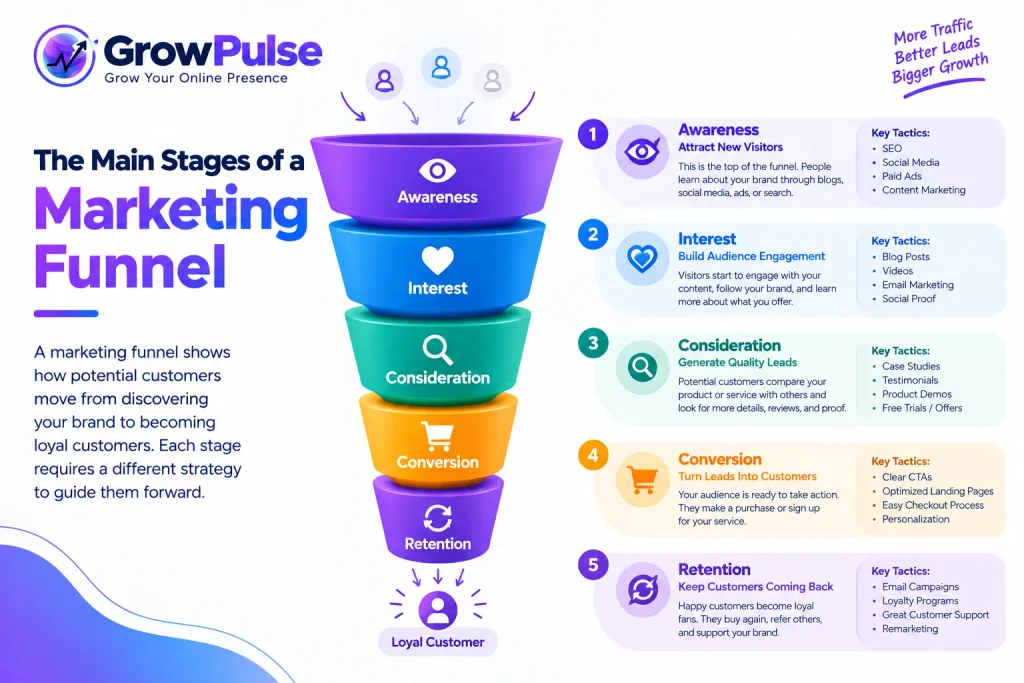
The Main Stages of a Marketing Funnel
1. Awareness
This is the top of the funnel.
At this stage, people may have a problem or interest but may not know your business yet.
Your job is to get their attention and provide useful information.
Common awareness content includes blog posts, social media content, videos, educational guides, and search-focused articles.
For example, someone searching for “how to improve website traffic” may discover your brand through a helpful SEO article.
2. Interest
Once people know about your brand, they may start exploring your content and learning more about what you offer.
This is where you can provide deeper educational content such as detailed guides, newsletters, webinars, case studies, and comparison articles.
The goal is to turn basic awareness into genuine interest.
3. Consideration
At the consideration stage, potential customers are actively evaluating their options.
They may compare different companies, services, tools, or products.
Content such as case studies, testimonials, demonstrations, detailed service pages, and comparison guides can be useful here.
Your focus should be on answering questions, reducing uncertainty, and showing why your solution is worth considering.
4. Conversion
This is the stage where a prospect takes the desired action.
Depending on your business, a conversion could mean:
- Making a purchase
- Filling out a contact form
- Booking a consultation
- Signing up for a service
- Requesting a quote
A strong call to action and a simple conversion process can make a significant difference at this stage.
5. Retention
The funnel should not necessarily end after the first purchase.
Existing customers can become repeat buyers, subscribers, or long-term clients.
Email marketing, customer support, useful content, loyalty programs, and personalized communication can help businesses maintain relationships with existing customers.
6. Advocacy
Satisfied customers can become valuable promoters of your brand.
Reviews, referrals, testimonials, social shares, and word-of-mouth recommendations can help bring new people into your funnel.
This creates a cycle where existing customers contribute to future growth.
How SEO Fits Into the Marketing Funnel
SEO can support multiple stages of the funnel.
Top-of-funnel content can target informational searches, while middle-of-funnel content can focus on comparisons and solutions.
Bottom-of-funnel pages can target searches with stronger commercial intent, such as service-related or product-related queries.
For example:
Awareness: “What is SEO?”
Consideration: “Best SEO tools for small businesses”
Conversion: “SEO services for small businesses”
This allows your website to attract people at different stages of the customer journey.
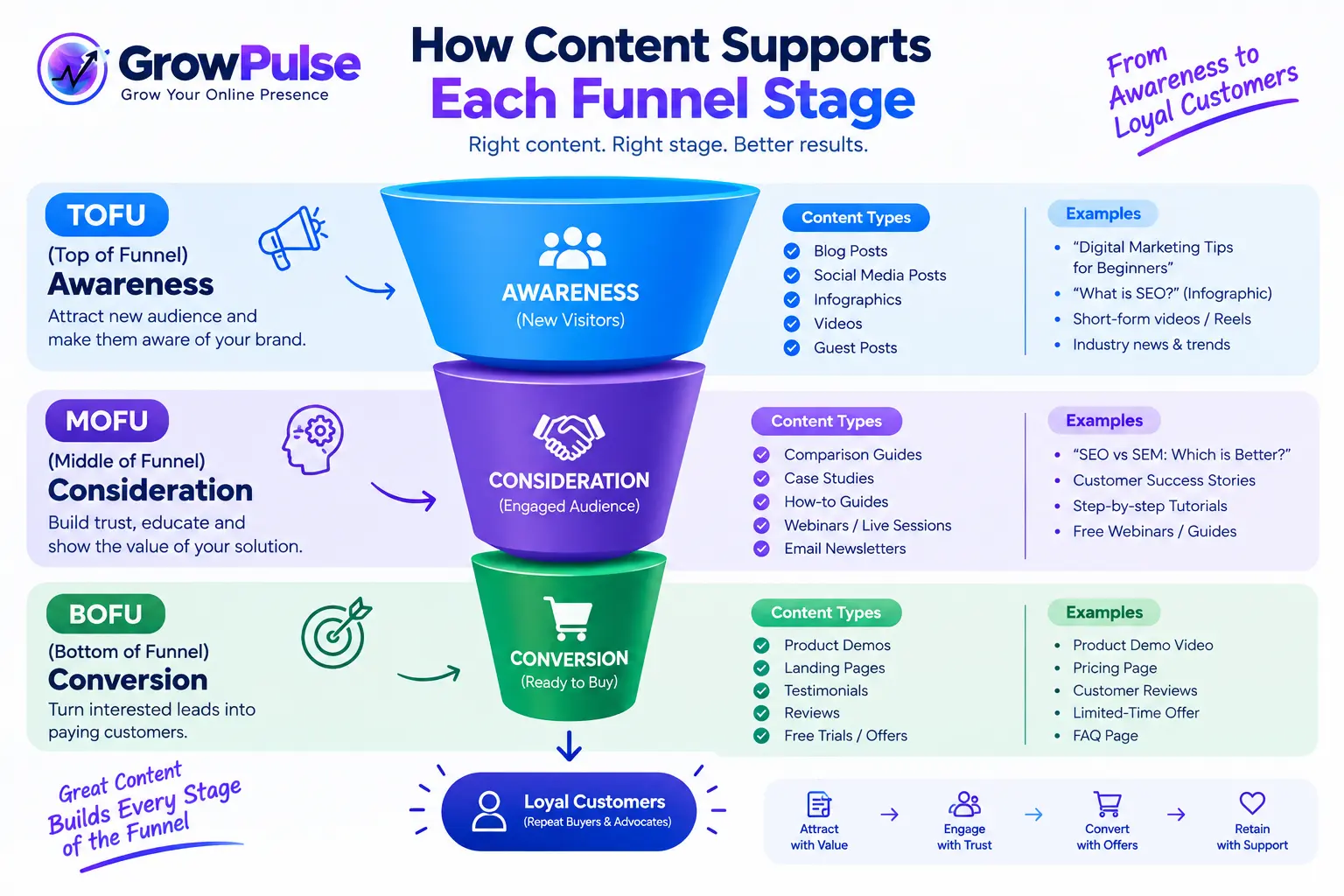
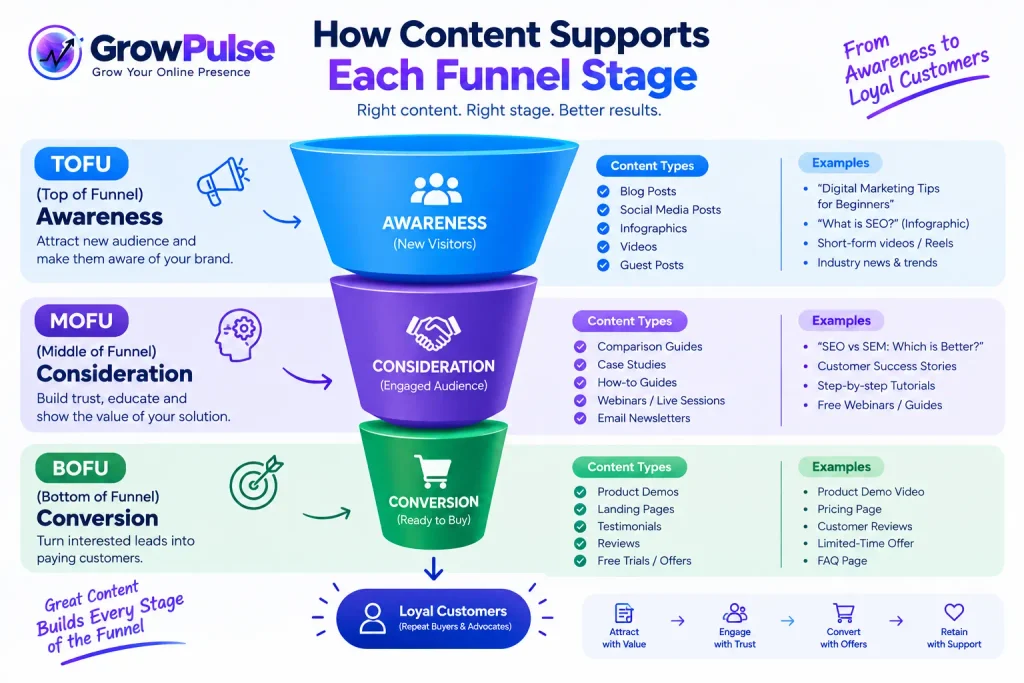
How Content Supports Each Funnel Stage
Your content strategy should match the intent behind the user’s search.
TOFU — Awareness:
Blog posts, guides, videos, and educational content.
MOFU — Consideration:
Comparisons, case studies, webinars, and detailed guides.
BOFU — Conversion:
Product pages, service pages, demos, testimonials, pricing, and consultation pages.
When each type of content has a clear purpose, your overall marketing system becomes much more effective.
Digital Marketing Funnel Example
Imagine a business offering SEO services.
A potential customer first discovers the company through a blog post about improving Google rankings.
They then read another article about keyword research and download an SEO checklist.
After receiving useful information through email, they visit the SEO services page and read client results.
Finally, they book a consultation.
This is a simple example of how a visitor can move from awareness to consideration and conversion.
Common Marketing Funnel Mistakes
One common mistake is focusing only on sales content.
Not every visitor is ready to buy. Some people need information and trust before making a decision.
Another mistake is creating content without a clear next step. Every important page should guide the visitor toward a logical action.
Businesses also sometimes ignore existing customers. Retention and customer experience are important parts of sustainable growth.
How to Improve Your Marketing Funnel
Start by identifying your ideal customer and understanding how they make decisions.
Then create content for each stage of the journey.
Track important metrics such as traffic, engagement, leads, conversion rate, customer acquisition cost, and sales.
Use the data to identify where potential customers are dropping out and improve that stage.
A funnel is not something you build once and forget. It should evolve as you learn more about your audience.
Frequently Asked Questions
What is a marketing funnel?
A marketing funnel is a model that represents the stages a potential customer goes through from discovering a business to becoming a customer.
What are the main stages of a marketing funnel?
The main stages can include awareness, interest, consideration, conversion, retention, and advocacy.
Is a marketing funnel only for online businesses?
No. Both online and offline businesses can use the funnel concept to understand customer journeys and improve marketing.
How does SEO help a marketing funnel?
SEO can attract users at different stages by targeting informational, commercial, and transactional search intent.
How long does it take to build a marketing funnel?
The time depends on the business, audience, channels, content, and conversion process. A simple funnel can be created quickly, while a mature funnel requires ongoing testing and optimization.
Final Thoughts
A marketing funnel gives you a clearer picture of how people move from discovering your brand to becoming customers and, ideally, loyal advocates.
The most effective funnels are not built around constant selling. They are built around understanding customer needs and providing useful information at every stage.
When SEO, content, social media, email marketing, and conversion-focused pages work together, your digital marketing efforts become easier to manage, measure, and improve.