
Getting visitors to your website is only half the job. The real challenge is getting those visitors to take action. They may purchase a product, submit a form, book a consultation, request a quote, or sign up for your service. This is where conversion rate optimization can make a major difference.
Conversion Rate Optimization, commonly known as CRO, is the process of improving a website or landing page so that more visitors complete a desired action.
For example, imagine your website gets 1,000 visitors in a month and 20 of them become customers. Your conversion rate is 2%. Instead of focusing only on getting more traffic, CRO helps you find ways to turn a greater percentage of your existing visitors into customers or leads.
In this beginner’s guide, you will learn what conversion rate optimization means, how to calculate conversion rate, which website elements affect conversions, and how to create a simple CRO strategy.
What Is Conversion Rate Optimization?
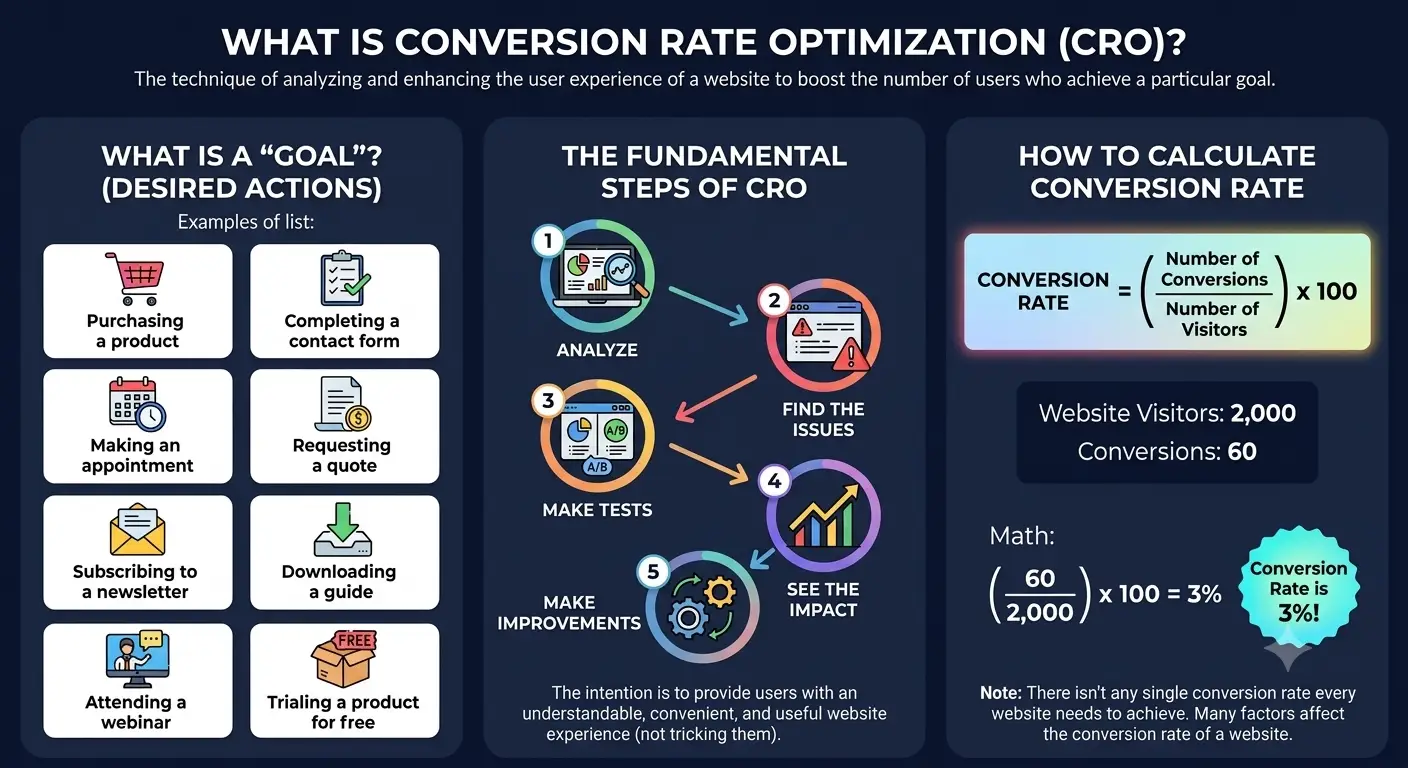
Conversion rate optimization is the technique of analyzing and enhancing the user experience of a website to boost the number of users who achieve a particular goal.
This could be one of the following:
- Purchasing a product
- Completing a contact form
- Making an appointment
- Requesting a quote
- Subscribing to a newsletter
- Downloading a guide
- Attending a webinar
- Trialing a product for free
The fundamental steps in CRO would be
Analyze → Find the Issues → Make Tests → See the Impact → Make Improvements
The intention is not to trick the users but rather to provide them with a more understandable, convenient, and useful website experience.
How to Calculate Conversion Rate
The basic formula for calculating conversion rate is
Conversion Rate = (Number of Conversions / Number of Visitors) x 100
If we take an example where the number of website visitors is 2,000 and the number of conversions is 60, then
60/2000 x 100 = 3%
Hence, the conversion rate is 3%.
But then there isn’t any one conversion rate that every website needs to achieve. There are many factors that affect the conversion rate of a website.
Why Is Conversion Rate Optimization Important?
CRO is essential, as it will help companies get maximum benefit from traffic they already have.
Get Maximum from Existing Traffic
It is not always necessary to get thousands of extra visitors. Sometimes, enhancing the experience of existing visitors will help you get more leads and/or sales.
Marketing Efficiencies
The fact that more people convert means that your current SEO, social media, and advertising campaigns become more efficient.
User Experience Improvements
Great CRO usually makes websites more understandable and navigable.
Increase of Leads and Sales
Effective optimization will increase the number of conversions from visitors.
Data-Driven Decisions
In CRO, you do not have to guess the needs of users; you can get analytics data, test your hypotheses, and ask for customers’ feedback.
What Factors Affect Conversion Rate?
There are many factors that can affect the conversion rate for visitors.
Headline
The headline of your page must convey the message of the page and make visitors interested.
Value Proposition
Visitors need to know why your offering is valuable or different.
CTA
The call to action should tell visitors what the next step would be for them.
For example:
- Get Started
- Book a Consultation
- Get a Free Quote
- Buy Now
Page Design
Good page design can help visitors easily locate valuable information.
Forms
Lengthy or unclear forms may create undue resistance.
Trust Factors
Testimonials, reviews, case studies, guarantees, and accurate company details may help to alleviate doubt.
Page Load Time
Slow-loading pages may result in a negative user experience.
10 Conversion Rate Optimization Strategies for Beginners
- 1. Create Clear Headlines
Visitors need to know the key advantage of your offer right away.
Do not use abstract headlines.
Rather than:
“Take Your Business to the Next Level”
Use:
“Generate More Qualified Leads Through Digital Marketing”
The latter expresses a more concrete advantage.
- 2. Use Strong Calls to Action
A CTA needs to be clear and relevant to the action that you want to take.
Learn More for someone researching your service.
Download the guide for someone interested in education.
Get a free quote for someone almost ready to buy.
Do not force the users to wonder what will happen next when they click the button.
- 3. Simplify Your Forms
Ask only for data that is required.
For instance, a standard lead generation form would require:
- Name
- Phone Number
- Requirement
Do not request 10 fields if you only need four.
The more straightforward the process, the less resistance there will be.
- 4. Improve Your Landing Pages
A landing page should have just one primary goal.
The best landing page will have:
Clear Headline
Tell your visitor about the offer right away.
Benefits
Demonstrate what the product or service does for the visitor.
Information
Answer key questions before the visitor decides to take action.
Social Proof
Include testimonials from customers.
Strong CTA
Make the next step crystal clear.
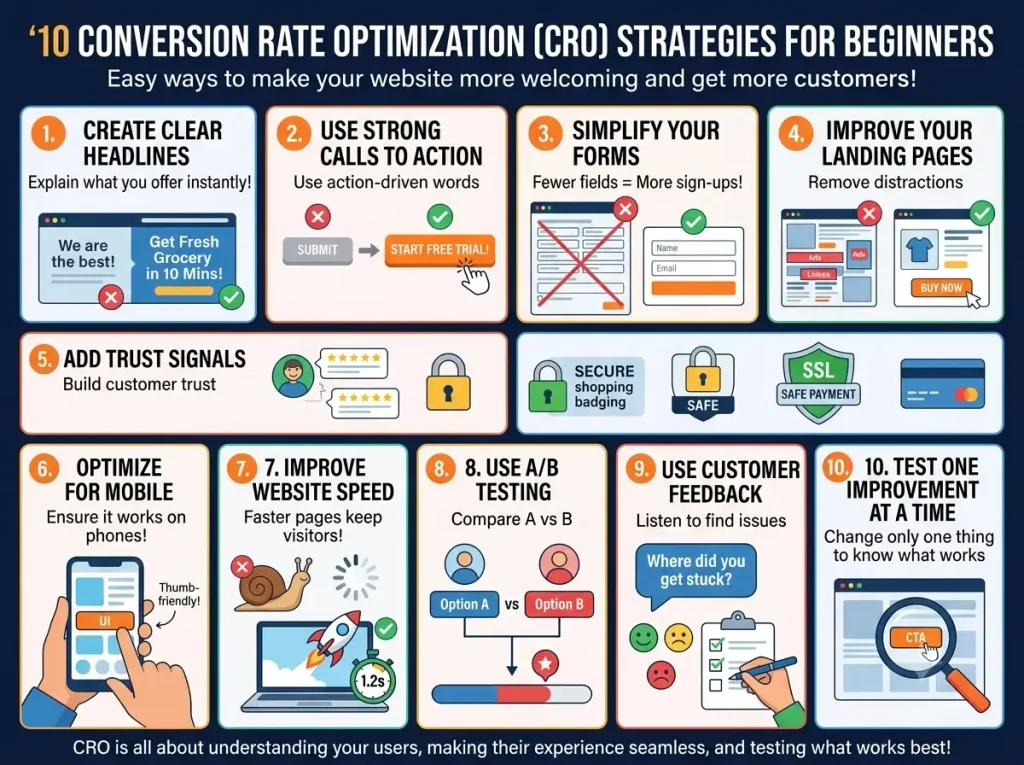
- 5. Add Trust Signals
People might be reluctant to patronize your organization due to uncertainty over its credibility.
The following are ways in which credibility can be enhanced:
- Real customer feedback
- References
- Case studies
- Secured payment data
- Contact information
- Policies
- Accreditation/Credentials
Always make claims that you can back up.
- 6. Optimize for Mobile
Your website should offer a smooth experience on smart phones and tablets.
Things to consider:
- Button size
- Readability
- Usability of forms
- Navigation
- Images
- Page speed
- Spacing
A page that is designed for desktop computers doesn’t necessarily work well on mobile devices.
- 7. Improve Website Speed
A sluggish site may irritate users before even showing your offer to them.
Consider such problems as
- Big image size
- Useless plug-ins
- Huge amount of scripts
- Bad hosting
- Unoptimized coding
All these factors should be improved.
- 8. Use A/B Testing
This involves comparing two versions of the page or element being tested.
For instance:
Version A: “Contact Us“
Version B: “Get Your Free Quote”
Then one can be able to test the two in the appropriate testing environment. However, do not change too many elements at once if one wants to know why there was a difference.
- 9. Use Customer Feedback
Analytic tools will tell you what your customers are doing, while feedback will tell you why they are doing it.
Use:
- Surveys
- Customer interviews
- Reviews
- Customer support conversations
- Feedback forms
You may ask:
What kept you from making a purchase?
Were there any confusing points?
What information was missing?
And many more.
- 10. Test One Meaningful Improvement at a Time
CRO is not a matter of changing everything at once.
Start from the biggest opportunity.
For instance:
- Problem: The visitors abandon the service page without making contact.
- Hypothesis: The CTA is not obvious enough.
- Test: Change the CTA from a general one to a specific one.
- Measurement: Compare the qualified conversions.
It is a repeatable process.
What Is A/B Testing in CRO?
A/B testing is a method of comparing two versions of a page, feature, or element.
For example:
A: “Submit”
B: “Get My Free Consultation”
Visitors are assigned to different versions, and the performance of each version is measured.
A good test should have:
- A clear hypothesis
- One meaningful change
- A defined conversion goal
- Enough data to make a reasonable comparison
Do not declare a winner simply because one version receives a few more conversions during a very short test.
CRO vs SEO: What Is the Difference?
However, SEO and CRO have different main objectives.
SEO aims to drive relevant organic traffic.
CRO, on the other hand, aims to convert this traffic into meaningful conversions.
Examples include:
SEO could help your website rank for:
“digital marketing services for small businesses”
Then, CRO will make the user aware of what you’re offering and whether to:
Schedule a Call → Request a Quote → Become a Client
This is why SEO and CRO complement each other well.
Traffic is good, but traffic becomes much better once it is converted into something meaningful.
How to Improve Conversion Rate on an E-Commerce Website
For e-commerce sites, consider the customer’s entire journey.
Product Pages
Need:
- Clear images of products
- Benefits
- Specifications
- Price
- Reviews
- Availability
- Clear CTA
Shopping Cart
Ensure the process is convenient for product browsing and quantity adjustment.
Checkout
Ensure the checkout process is straightforward.
Payment
Provide secure and convenient payment methods and inform customers about the security measures.
Post Purchase
Communicate with customers and ensure it’s easy for them to contact customer service or make repeat purchases.
How to Improve Conversion Rate for a Service Business
Inquiries, phone calls, booking, or consultations can be key elements for service-based businesses.
Here you should pay attention to:
- High-quality service pages
- Value propositions
- Client testimonials
- Case studies
- Simple forms
- Booking options
- Pricing information
- Effective calls to action
Instead of “Contact Us,” use:
“Book Your Free Consultation”
It is obvious what you want your visitors to do.
Important CRO Metrics to Track
Conversion rate is crucial, yet it must not be your only KPI.
Conversion Rate
Percentage of users that perform the desired action.
Form Submission Rate
Can be helpful for landing pages that serve as sources of leads.
Cart Abandonment Rate
Essential metric for online shopping websites.
Average Order Value
Can give insight into the average amount of money made from each purchase.
Customer Acquisition Cost
Gives information about customer acquisition costs.
Revenue per Visitor
Allows measuring the connection between website traffic and business performance.
Lead-to-Customer Conversion Rate
Particularly helpful for services/B2B companies.
Common Conversion Rate Optimization Mistakes
- Changes All Over The Place
When everything changes at once, it’s hard to know what made the impact.
- Copying Your Competitors
Just because something is working for someone else doesn’t mean it will work for your audience.
Use competitors for research purposes, but never as a replacement for testing.
- Concentrating On Button Design Alone
CRO is more than button color.
Your offer, messaging, credibility, pricing, usability, and user intent could all play a role.
- Overlooking Your Mobile Audience
A bad mobile experience can cause problems for users.
- Getting Too Hungry For Conversions
More conversions aren’t necessarily better.
For instance, you could end up getting more form fills but fewer qualified leads.
Always think about conversion quality as well as quantity.
A Simple Conversion Rate Optimization Process
Beginners can use this simple framework:
Beginners can use this simple framework:
Step 1: Find the Problem
Use analytics and feedback to identify pages or steps that underperform.
Step 2: Understand the User
Study what visitors need, expect, and struggle with.
Step 3: Create a Hypothesis
Write down what you think will improve performance and why.
Step 4: Test the Change
Run an appropriate experiment or controlled comparison.
Step 5: Analyze the Result
Measure whether the change improved the target outcome.
Step 6: Keep Improving
CRO is an ongoing process rather than a one-time project.
Beginner CRO Checklist
Before publishing a landing page, check:
Clear headline?
Strong value proposition?
One primary CTA?
Simple form?
Mobile-friendly design?
Fast loading?
Relevant trust signals?
Easy navigation?
Measurable conversion goal?
Testing plan?
If the answer is yes to most of these questions, you have a strong starting point.
Final Thoughts
Conversion rate optimization is all about getting more visitors to do something on your site.
You don’t always have to get more traffic to achieve better results for your business. Sometimes you may benefit from doing things after the visitor arrives at your site.
Get the fundamentals in order—clarity, improved call-to-action, better forms, increased trust, improved mobile usability, and analyzing the data.
Instead of making random adjustments, try testing important things.
Conversion rate optimization is more effective as a continuous process of learning and improvement.
Get more qualified traffic. Eliminate any unnecessary friction. Maximize the value of each visit.
Frequently Asked Questions
What is conversion rate optimization?
Conversion rate optimization is the process of refining a web experience in order to maximize the number of users who take a certain action on the website.
What is a good conversion rate?
There is no such thing as an acceptable conversion rate for all websites. It differs depending on the industry, target audience, traffic source, offer, type of device, and conversion goal.
Is CRO only for online stores?
Answer: No. CRO can help e-commerce sites, service firms, SaaS firms, B2B sites, blogs, and lead generation sites.
How can I improve my website conversion rate?
Begin with value proposition, headline, CTA, landing page, form optimization, trust, mobile usability, and page speed improvements. Then test your results.
Does CRO help SEO?
The aim of CRO is not the same as SEO, but the two are interrelated. Through SEO, traffic that could become leads or customers can be drawn to the website.
What should I test first?
Begin with big-ticket items like your offer, headline, CTA, page layout, form frictions, and trust indicators.