
When businesses want to increase website traffic and reach more customers online, they often compare SEO vs PPC. Both marketing channels can help bring visitors to your website. However, they work in different ways and are suitable for different goals.
SEO focuses on improving your website’s organic visibility in search engines. On the other hand, PPC helps you place paid advertisements in front of people who are searching for specific products or services.
So, which one should your business choose?
The answer depends on your budget, goals, competition, industry, and how quickly you want results. For example, SEO can help build a strong source of organic traffic over time, while PPC can provide targeted traffic much faster. Therefore, understanding the difference between SEO and PPC is important before you invest your time or money.
In this guide, we will compare SEO and PPC in simple terms. You will learn how they work, their benefits and drawbacks, costs, expected results, and when you should use each marketing channel.
What Is SEO?
SEO stands for Search Engine Optimization. It is the process of improving a website so that it can appear more prominently in organic search results.
When someone searches for a product, service, or answer on Google, search engines analyze many factors to decide which pages should appear in the results.
SEO involves areas such as
- Keyword research
- Helpful content
- On-page optimization
- Technical SEO
- Internal linking
- Website performance
- Backlinks and authority
Unlike paid advertising, you do not directly pay a search engine every time someone clicks your organic result.
How Does SEO Work?
SEO starts with understanding what your target audience searches for.
You then create useful content and optimize your website around relevant search terms. At the same time, you improve technical elements and build website authority.
For example, a business selling digital marketing services might create a detailed article targeting the keyword “digital marketing strategy.”
If the content is useful, well-optimized, and competitive enough, it may rank organically and attract search traffic over time.
What Is PPC?
PPC stands for pay-per-click advertising.
With PPC, businesses pay to display advertisements on platforms such as search engines and social networks. In search advertising, advertisers can often bid on keywords so that their ads appear when users search for related terms.
The advertiser usually pays when someone clicks the advertisement.
For example, a company offering SEO services could create a PPC campaign targeting searches related to SEO services. The ad may appear near the top of the search results.
How Does PPC Work?
PPC campaigns generally involve selecting an audience, choosing keywords or targeting options, creating advertisements, setting a budget, and monitoring performance.
The advantage is speed.
Once a campaign is approved and running, your business can start receiving targeted visitors almost immediately. However, good results still depend on the quality of your targeting, landing page, advertisement, offer, and budget.
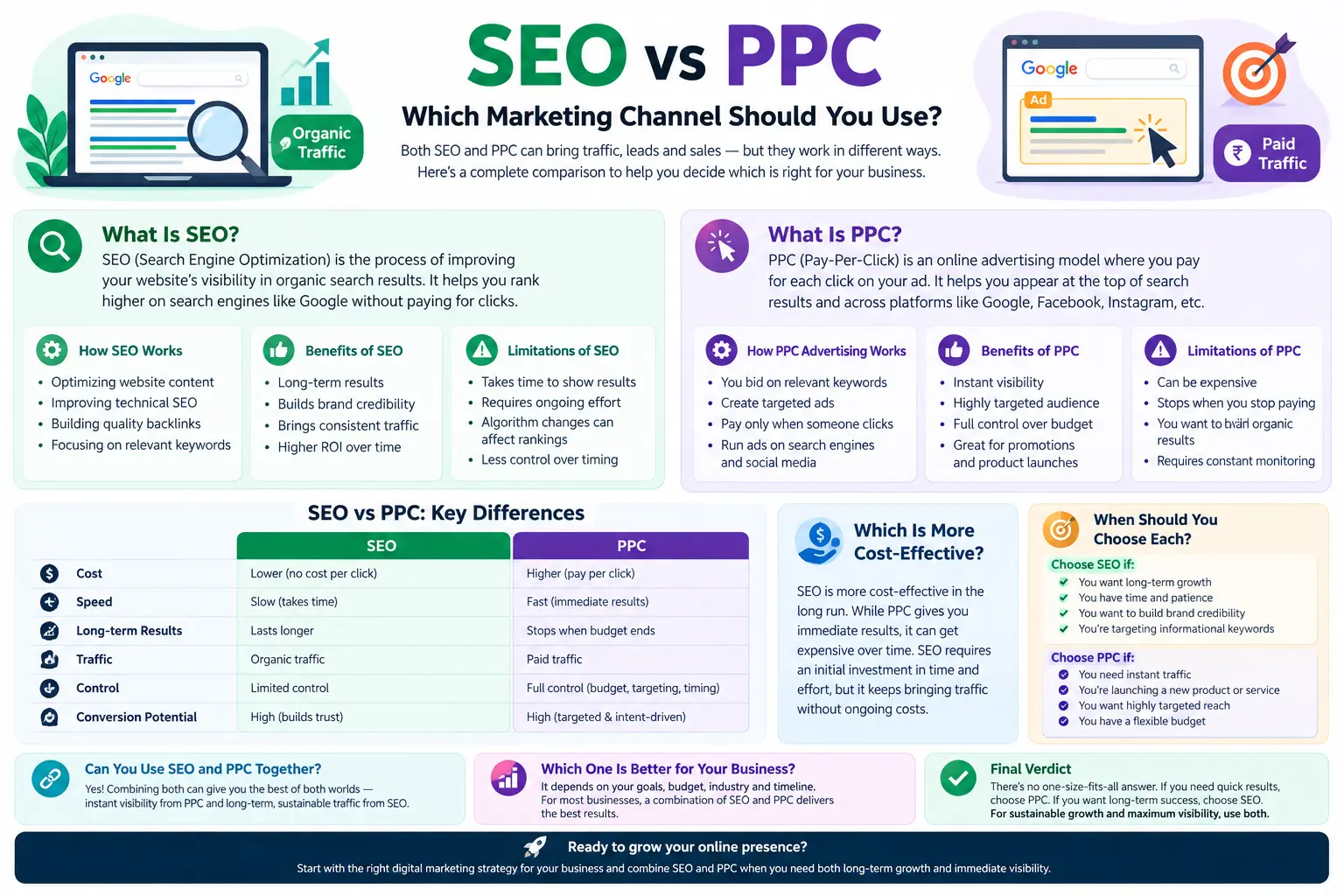
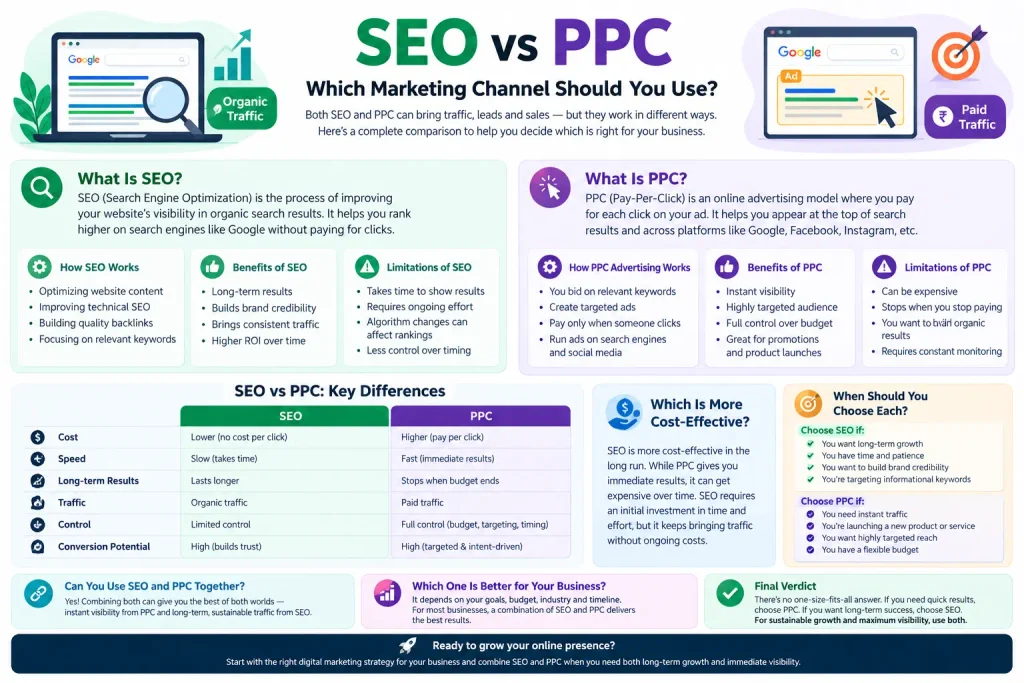
SEO vs PPC: Key Differences
SEO and PPC can both generate website traffic, but the way they generate that traffic is very different.
| Factor | SEO | PPC |
| Traffic Type | Organic | Paid |
| Cost Model | Mainly investment in content, SEO, and resources | Usually pay per click or conversion. |
| Speed | Usually slower | Usually faster |
| Long-Term Value | Strong potential | Depends on continued ad spend |
| Control | Moderate | High |
| Testing Speed | Slower | Faster |
| Visibility | Earned | Purchased |
| Best For | Long-term growth | Immediate targeted traffic |
The biggest difference is simple: SEO earns visibility, while PPC buys visibility.
Benefits of SEO
SEO offers several advantages for businesses that want sustainable online growth.
1. Long-Term Traffic Potential
A successful SEO page can continue attracting organic visitors long after it has been published.
For example, a useful article that ranks well can generate traffic every month without paying for every individual click.
2. Builds Authority
High-quality content can help establish your business as a reliable source of information.
When people repeatedly find your website while searching for answers, your brand can become more recognizable and trustworthy.
3. Lower Direct Cost Per Click
Organic search results do not charge you for every click.
That does not mean SEO is free. You still need to invest in strategy, content, optimization, tools, and expertise. Nevertheless, the traffic can become highly valuable over time.
4. Supports the Entire Content Strategy
SEO encourages businesses to understand customer questions and create useful content around them.
This content can also be reused in email campaigns, social media, videos, and other marketing channels.
Drawbacks of SEO
SEO also has limitations.
The biggest challenge is time. Ranking for competitive keywords can take months or longer.
Search rankings can also change because of competition, search engine updates, and changes in user behavior.
Furthermore, SEO requires consistency. Publishing one article and doing nothing else is rarely enough for competitive markets.
Benefits of PPC
PPC can be especially useful when a business wants immediate exposure.
1. Faster Results
Unlike SEO, PPC does not require you to wait for a page to rank organically.
Once the campaign starts, your ads can appear in front of targeted users.
2. Precise Targeting
PPC platforms provide different targeting options depending on the platform.
You can often target users based on search terms, location, interests, demographics, audiences, and other signals.
3. Easy Performance Tracking
PPC campaigns can provide detailed performance data.
You can monitor impressions, clicks, conversions, cost per click, cost per lead, and return on ad spend.
As a result, businesses can quickly identify which campaigns and messages are performing well.
4. Useful for Testing
PPC is also useful for testing keywords, offers, landing pages, and advertising messages.
The data from these campaigns can sometimes provide useful insights for other parts of your digital marketing strategy.
Drawbacks of PPC
The biggest disadvantage of PPC is ongoing cost.
When you stop paying for advertising, the paid traffic generally stops as well.
Competition can also make popular keywords expensive. Therefore, simply increasing your advertising budget does not guarantee profitability.
A weak landing page or poorly targeted campaign can also waste money.
SEO vs PPC: Which Is Better for Your Business?
There is no universal winner.
The better option depends on what your business needs.
Choose SEO When:
You want to build long-term organic traffic.
You have time to invest in content and optimization.
You want to establish authority in your industry.
You are targeting informational search queries.
You want to reduce dependence on paid traffic over time.
Choose PPC When:
You need traffic quickly.
You are launching a new offer or product.
You want precise audience targeting.
You want to test a market or message quickly.
You have a clear conversion funnel and advertising budget.
Should You Use SEO and PPC Together?
In many cases, the answer is yes.
SEO and PPC do not have to compete with each other. They can work together as part of the same digital marketing strategy.
For example, PPC can generate immediate traffic while your SEO efforts are building organic visibility.
At the same time, PPC data can help you understand which keywords and offers attract conversions. You can use those insights to strengthen your SEO and content strategy.
This combination can create a more balanced marketing system.
SEO + PPC Example
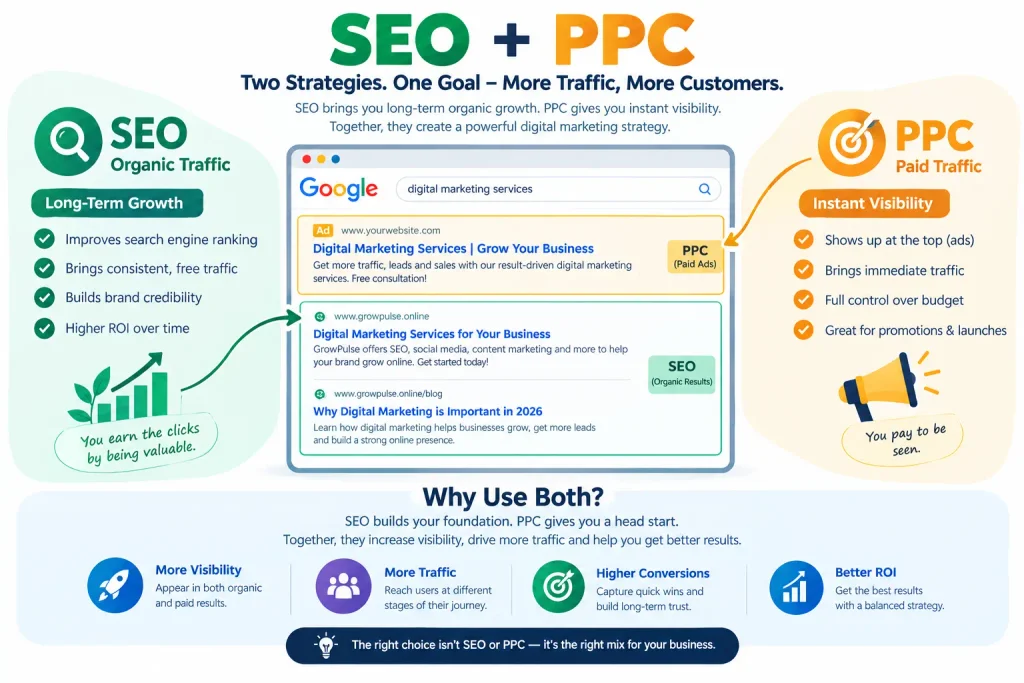
Imagine a company launches a new digital marketing service.
The business uses PPC to immediately reach people searching for related services. At the same time, it publishes SEO-focused blog posts, improves service pages, and builds relevant backlinks.
After several months, the website may begin receiving more organic traffic.
The business can then use both channels:
PPC → Immediate traffic
SEO → Long-term organic growth
Together, they can reduce the risks of depending entirely on one channel.
SEO vs PPC Cost
Cost is one of the most common questions businesses ask.
However, comparing SEO and PPC only by price can be misleading.
With PPC, you typically have a direct advertising cost. You may also need to pay for campaign management, creative work, landing pages, and conversion optimization.
SEO usually involves costs related to content creation, technical improvements, tools, link building, and professional expertise.
Therefore, the better question is not simply
“Which one is cheaper?”
Instead, ask:
“Which channel can generate the best return for my business goals?”
A channel that costs more but produces profitable customers may be more valuable than a cheaper channel that produces little business.
SEO vs PPC for Small Businesses
Small businesses often have limited budgets, so choosing where to invest matters.
SEO can be a strong choice when the business can create useful content consistently and compete for realistic search terms.
PPC can make sense when the business has a proven offer, a good conversion process, and wants faster results.
In many situations, starting with a focused strategy and testing results is better than spending the entire budget across multiple channels.
How to Choose Between SEO and PPC
Before deciding, ask yourself these questions:
What Is Your Goal?
Do you want immediate leads, long-term traffic, brand visibility, sales, or a combination?
What Is Your Budget?
A paid campaign requires an ongoing advertising budget. SEO requires investment in content and optimization.
How Competitive Is Your Market?
Highly competitive SEO keywords may take significant effort to rank for. Similarly, competitive PPC keywords may have high click costs.
How Quickly Do You Need Results?
If you need customers quickly, PPC may offer faster visibility.
If you are building long-term growth, SEO may be more suitable.
What Is Your Conversion Rate?
Driving traffic is not enough.
You need a landing page, offer, website, or sales process that can turn visitors into leads or customers.
Common Mistakes to Avoid
One mistake is treating SEO as completely free.
SEO may not charge per click, but it requires time, resources, and expertise.
Another mistake is running PPC without tracking conversions. Clicks are not the same as customers.
Some businesses also choose highly competitive keywords without considering their budget or resources.
Finally, avoid choosing a channel simply because it is popular. Your strategy should be based on your audience and business objectives.
Frequently Asked Questions
Is SEO better than PPC?
Neither is automatically better. SEO is often better for long-term organic growth, while PPC can be better when you need faster and more targeted traffic.
Is PPC faster than SEO?
Yes. PPC can generate paid traffic shortly after a campaign becomes active. SEO usually takes longer because pages need to gain visibility and compete in organic search results.
Is SEO cheaper than PPC?
Not necessarily. SEO does not normally have a direct cost for each click, but businesses still spend money on content, optimization, tools, and expertise.
Can SEO and PPC be used together?
Yes. Using both can provide immediate paid visibility while building long-term organic traffic.
Which is better for a new website?
A new website can potentially benefit from both. PPC may help generate initial traffic, while SEO can build long-term organic visibility.
Final Thoughts
The SEO vs PPC debate does not have to end with choosing only one.
SEO is a long-term investment that can help build organic visibility, authority, and sustainable traffic. PPC, meanwhile, can provide faster exposure and precise targeting when you have a suitable budget and conversion strategy.
For many businesses, the strongest approach is to use both strategically.
Start with your business goals. Understand your audience. Test what works. Then invest more in the channels that produce real results.
The right marketing channel is not the one that gets the most clicks. It is the one that helps your business achieve its goals profitably and consistently.